If you stepped away from your company for two weeks, what would actually happen?
Not the optimistic answer.
The operational one.
Would execution continue at the same standard?
Would decisions move forward without hesitation?
Would performance remain stable without your intervention?
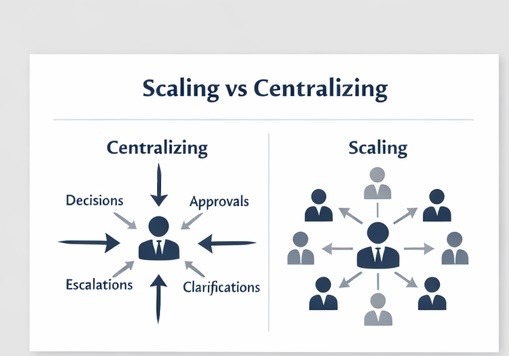
If the answer is no, the business is not scaling.
It is centralizing.
And centralization has a structural ceiling, no matter how fast revenue grows.
The Misinterpretation of Growth:
Many founders assume growth equals scale. Revenue increases, the team expands, activity intensifies. The organization looks larger, more sophisticated, more alive.
Yet internally, something subtle often occurs: founder involvement rises in parallel with revenue.
More approvals.
More clarifications.
More escalations.
More oversight.
The company grows in size but not in independence.
That distinction is critical.
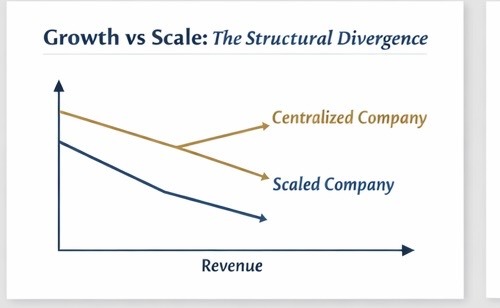
Scale is not revenue expansion. Scale is structural independence at higher levels of complexity.
If complexity increases and dependency increases with it, the organization is not scaling. It is concentrating execution at the top.
The Structural Force Few Founders Recognize:
We call this execution gravity.
Execution gravity is the predictable structural pull that draws ambiguity, decision-making, and accountability upward as operational volume increases.
It emerges when:
- Decision rights are implied rather than explicitly defined.
- Ownership exists nominally but not operationally.
- Workflows depend on conversation instead of architecture.
- Accountability is enforced through oversight rather than systems.
As growth introduces more moving parts, ambiguity multiplies. And ambiguity always moves upward toward the most capable decision-maker, typically the founder.
The founder does not become the bottleneck by choice.
The structure makes it inevitable.
Why Hiring Rarely Solves the Problem:
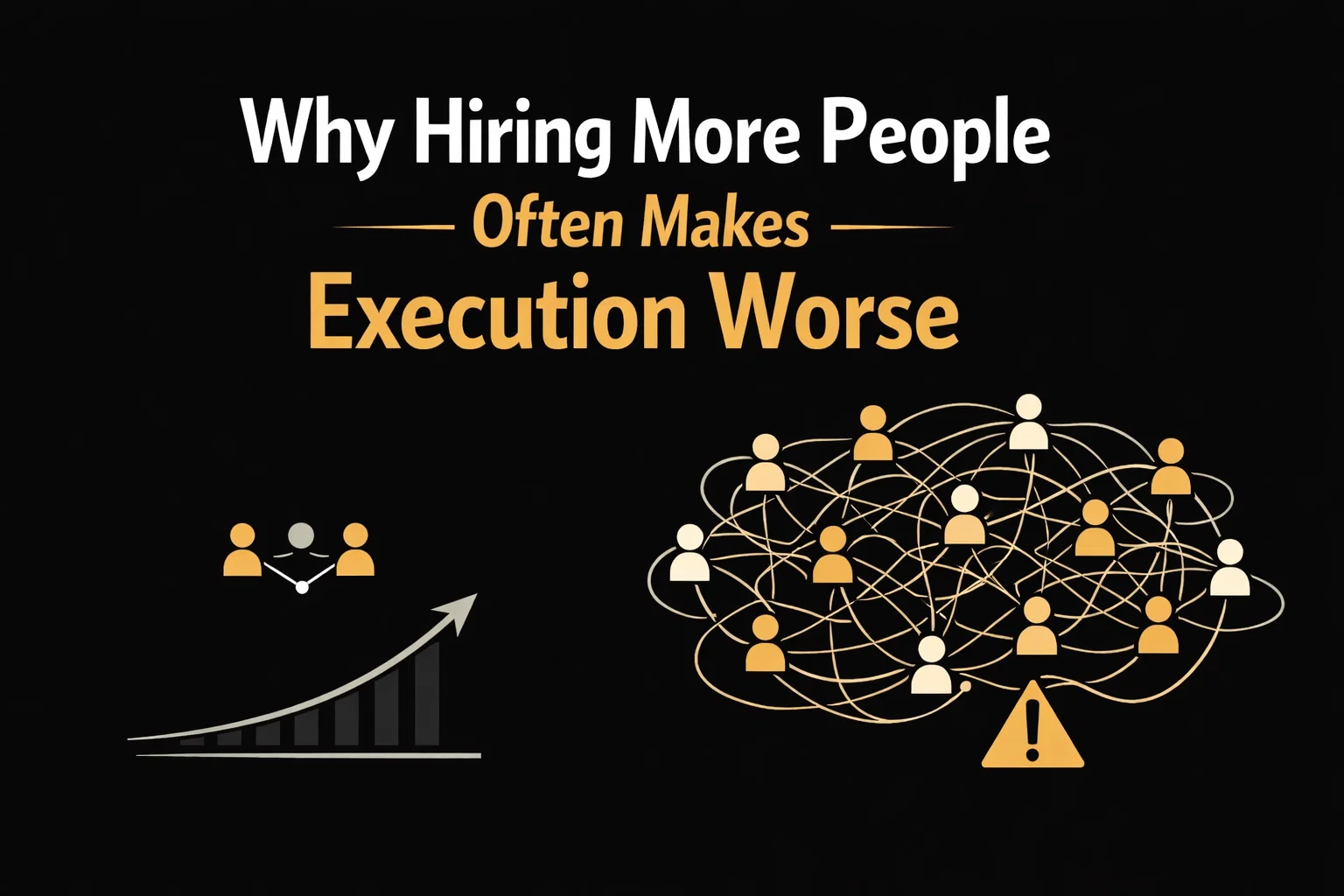
At this stage, the instinct is to add headcount.
More managers.
More coordinators.
More operational roles.
But people layered onto unclear systems amplify variability rather than reduce it. Additional communication channels increase interpretation risk. Escalation patterns remain unchanged.
Headcount increases.
Structural independence does not.
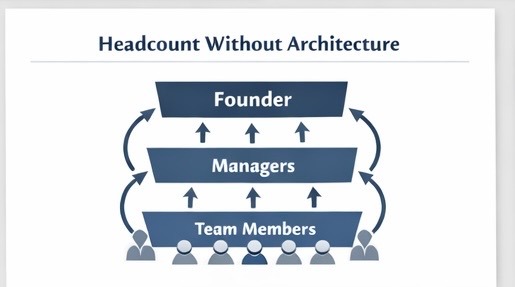
The founder remains the integrator of last resort.
This is why many companies between $500K and $5M experience a plateau that feels mysterious. Revenue is present. Demand exists. Talent has been hired.
Yet capacity does not expand proportionally.
Because capacity is not created by effort. It is created by architecture.
A Real Example: When Growth Became Friction
A service-based company generating just over $1.8M annually approached Executo with what initially appeared to be a hiring problem.
They had added two managers in six months. Revenue was stable. Demand was strong.
Yet the founder felt more involved than ever.
Cross-functional issues still escalated upward. Managers required clarification on decision boundaries. Projects slowed whenever ambiguity surfaced. Hiring had increased payroll, but not independence.
On paper, the organization had grown.
Structurally, nothing had changed.
After a structural diagnostic, the issue was clear: execution gravity was pulling every exception and gray-area decision back to the founder because ownership boundaries were undefined and workflows were conversational rather than architectural.
Instead of hiring again, structural intervention focused on three areas:
- Decision rights were explicitly mapped across leadership roles.
- Core workflows were rebuilt to eliminate vertical escalation patterns.
- Accountability loops were implemented to replace oversight with measurable execution checkpoints.
Within four months:
- Founder involvement in day-to-day decision-making decreased by over 40%.
- Project cycle time improved by 22%.
- Managers began resolving cross-functional issues laterally without escalation.
- Revenue grew the following quarter without increasing operational strain.
The business did not grow because more people were added.
It grew because structural leverage was engineered.
That is the difference between expanding and scaling.
The Real Definition of Scale:
A business is scalable when execution no longer relies on constant founder involvement.
Specifically:
Decision boundaries are defined before ambiguity arises.
Ownership resolves issues laterally, not vertically.
Workflows are engineered to absorb complexity without improvisation.
Accountability is system-driven, not personality-driven.
This is structural leverage.
Structural leverage allows revenue to grow without proportional increases in founder load.
Without it, growth compounds pressure. With it, growth compounds capacity.
Where Most Companies Get It Wrong
Most operational improvements focus on optimization, better tools, better meetings, better communication practices.
Optimization refines motion.
Architecture determines direction.
If the underlying execution model is centralized, optimizing it only makes centralization more efficient.
True scale requires redesign, not refinement.
That is where most consultancies stop.
And where structural execution work begins.
Executo’s Approach: Engineering Structural Leverage:
Executo does not treat busyness as a productivity issue. It treats it as a structural design flaw.
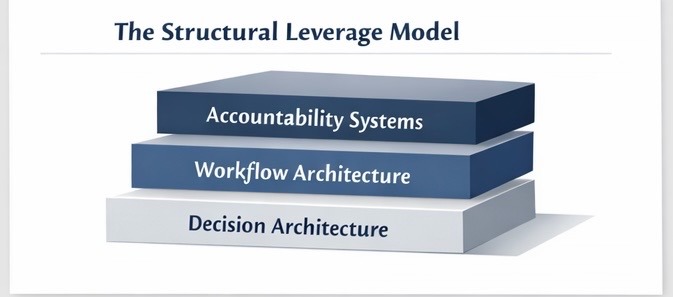
Instead of increasing activity, execution gravity is removed through deliberate architectural intervention across three layers:
Decision Architecture
Decision rights are explicitly designed. Escalation pathways are defined in advance. Authority boundaries are clarified before pressure tests them.
When decision flow is engineered, upward dependency decreases naturally.
Workflow Architecture
Execution pathways are mapped and rebuilt so that work resolves horizontally across accountable owners rather than vertically toward the founder.
This eliminates personality-driven processes and replaces them with engineered flow.
Accountability Systems
Founder oversight is replaced with structured accountability loops, measurable checkpoints, defined performance indicators, and operational visibility that do not require constant supervision.
Oversight becomes embedded in the system.
Not dependent on presence.
What Changes When Structure Changes:
When execution gravity is removed, growth behaves differently.
Hiring increases capacity instead of complexity.
Revenue increases without proportional stress.
Strategic thinking replaces operational firefighting.
The founder shifts from integrator to architect.
Most importantly, the organization becomes resilient to absence.
That is scale.
Not busyness.
Not expansion.
Not survival at higher revenue.
Scale.
The Real Question:
If your business feels active but structurally fragile, the issue is not ambition.
It is architecture.
And architecture can be redesigned.
Executo operates precisely at that inflection point, where commercially successful companies require structural evolution to unlock their next stage of growth.
Structural execution.
Because until execution independence is engineered, revenue growth will continue to increase involvement rather than reduce it.
And that is the invisible ceiling most founders never see, until they feel it.
Structural Clarity Starts with Diagnosis
Before increasing revenue further, the more important question is this:
Is your execution model built to absorb more complexity, or amplify it?
Executo begins every engagement with a structural diagnostic, not a pitch.
A focused evaluation of decision architecture, workflow integrity, and accountability design, to identify exactly where execution gravity exists inside your organization.
If growth feels heavier than it should, it’s time to examine the structure behind it.
Request a Structural Clarity Session at Executo.ca and assess whether your business is expanding, or engineered to scale.