Why Hiring More People Often Makes Execution Worse
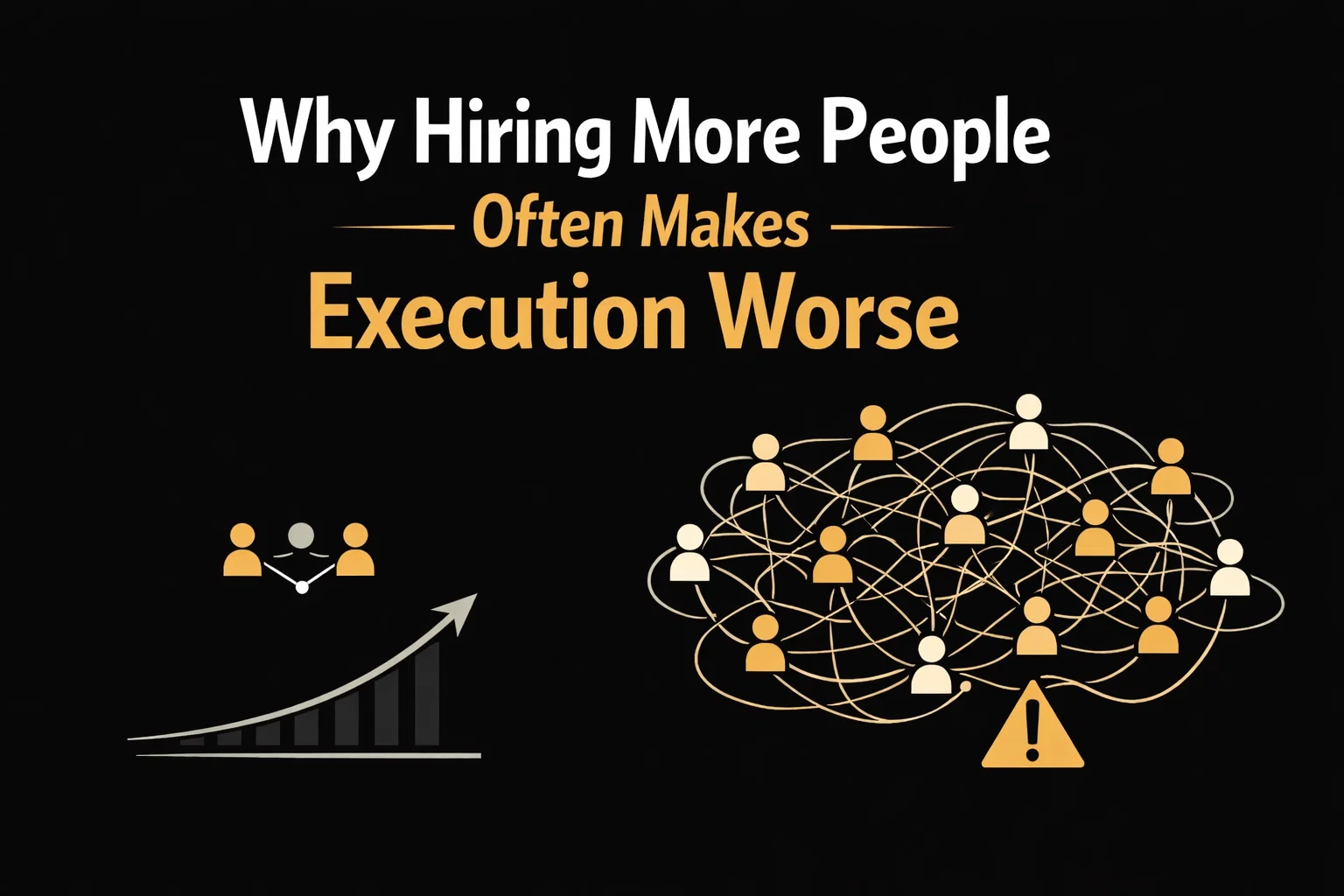
Adding people feels like progress. It looks like investment. It signals seriousness. But inside your execution model, each new hire doesn't just add capacity — they add complexity. And complexity, without architecture to contain it, destroys speed.
There's a moment most growing founders know well. Delivery is slipping. The team feels stretched. Clients are waiting too long. The obvious answer announces itself: hire more people.
And so you do. A project coordinator. A second account manager. Another developer. The payroll grows. The org chart fills in. For a brief moment, it feels like you've solved something.
Then, three months later, execution is somehow slower than before.
This isn't a coincidence, and it isn't bad luck. It is the predictable result of adding people to a system that was never designed to absorb them.
The Headcount Fallacy
We've been conditioned to treat headcount as a proxy for capacity. Bigger team, more output. It's an intuitive equation — and it's almost always wrong at the operational level.
The reason comes down to communication math. When you have two people on a project, there is one communication link between them. Add a third person, and you have three links. A fifth person creates ten. A tenth person creates forty-five. The formula — n(n-1)/2 — means communication overhead doesn't grow linearly with headcount. It compounds.
This means that every time you add a person, you are not just adding one more voice — you're adding a web of new dependencies, handoffs, assumptions, and misalignments that didn't exist before.
And if your workflows were already held together by informal understanding rather than explicit design, those new links will carry noise, not signal.
Why People Make Broken Systems Worse
There is a seductive logic to the hiring response: we can't keep up, so we need more capacity. But capacity and execution are not the same thing.
Execution is the rate at which work moves through your system and produces the right outcome. Capacity is simply the volume of work a team is capable of processing. You can have enormous capacity and terrible execution when the system connecting people doesn't work.
When you hire into a structurally broken system, you get more people experiencing the same friction. You get more coordination overhead on top of the overhead that was already slowing you down. You get more interpretations of unclear roles. More escalations to the founder. More meetings to resolve the ambiguity that process was supposed to resolve.
People layered onto unclear systems amplify variability rather than reduce it. The founder remains the integrator of last resort — not by choice, but by structural design.
The dysfunction scales with the team. The founder, rather than stepping back, finds themselves more involved than ever — because more people means more things going in slightly different directions, all requiring someone at the center to reconcile them.
The Four Stages of Hiring-Induced Slowdown
This pattern follows a predictable arc. Understanding where you are in it is the first step to breaking out of it.
Most founders cycle between Stage 1 and Stage 4 repeatedly. Each cycle adds headcount. Each cycle ends in the same place. The diagnosis never changes because the structure never changes.
What Actually Drives Execution Speed
If headcount doesn't solve execution problems, what does? The answer lives in three structural elements that most growing companies have never deliberately designed.
Decision clarity. Every time a decision requires escalation to the founder, execution pauses. In most organizations, decision rights are implied rather than explicit — people know roughly what falls under their authority, but not precisely. The moment ambiguity enters, the decision travels upward. Explicit decision boundaries, defined in advance, eliminate this upward pull at source.
Workflow architecture. Most execution problems are really workflow problems. Work moves through organizations in one of two ways: through defined pathways, or through conversation and improvisation. Defined pathways scale. Improvisation doesn't. When a process depends on someone knowing to check in with someone else, or on a Slack message being sent at the right moment, you have a conversational workflow. It works when the team is small and everyone is in the same room. It fails at scale.
Accountability loops. The default accountability mechanism in most growing companies is oversight — the founder checks in, reviews, and catches issues. This is unsustainable and doesn't transfer when the founder is absent. Accountability systems replace oversight with visibility: measurable checkpoints, clear owners, and embedded performance indicators that surface problems without requiring supervision.
The Right Order of Operations
This doesn't mean never hire. It means hire in the right sequence.
The structural question comes first: Is the work designed to be handed off? Are workflows explicit enough that a new person could follow them without the founder translating? Are ownership boundaries defined? Are accountability mechanisms in place so that the founder doesn't need to monitor every outcome personally?
If the answer is yes — if the architecture exists — then a new hire drops into a system that absorbs and directs their effort. They add capacity. Execution improves. The investment compounds.
If the answer is no, the new hire inherits an undefined role, learns to work around broken processes, and adds a new set of interpretations on top of existing ambiguity. Execution slows. The founder fills the gaps. The cycle continues.
Execution is not a people problem. It is a systems problem that hiring turns into a more expensive systems problem.
Build the Architecture First
The instinct to hire is understandable. Growth creates genuine capacity pressure, and people are the most visible way to add capacity. But execution is not a volume problem — it is a design problem.
Before your next hire, run a simpler test: could someone step into this role tomorrow, with no briefing from you, and know exactly what they own, how their work flows, and what good looks like? If the answer requires you to be in the room, the system isn't ready for another person. It's ready for architecture.
Build the structure that makes hiring work. Then hire into it. That is the sequence that compounds instead of complicates.
Is Your Execution Model Built to Scale?
Executo begins every engagement with a structural diagnostic — not a pitch. We identify exactly where execution gravity is holding your business back before recommending any intervention.
Request a Structural Clarity Session