The Hidden Leaks That Drain Time, Profit, and Momentum
Most businesses don't collapse from one catastrophic mistake. They erode — quietly, continuously — through a hundred small openings nobody is watching closely enough to close.
The revenue looks healthy on paper. The team is busy — genuinely, visibly busy. And yet the bank balance doesn't quite match the effort, the week disappears faster than it should, and growth feels like it's happening to someone else's business. Nothing dramatic went wrong. There was no single bad decision, no one moment you could point to and say, "that's where it broke."
That's usually the story. Businesses rarely fail from one burst pipe. They fail from a dozen small, tolerated drips — a slow leak in the schedule here, a few points of margin there, a decision that quietly stalled for two weeks and cost the team its rhythm. Individually, each one looks too small to fix. Together, they are the difference between a business that compounds and one that just stays busy.
That gap has a name: the hidden leak. And the founders who find and seal it are almost never the ones working the hardest. They're the ones who stopped assuming their business was as efficient as it felt.
A leak is never one dramatic failure. It's a small, tolerated gap — repeated often enough that it becomes the business's default operating cost.
The DefinitionWhat a "Leak" Actually Is
A loss announces itself. A client churns, an invoice bounces, a project fails — and the business reacts, because the pain is immediate and visible. A leak does none of that. It doesn't show up on a P&L line, it doesn't trigger an alarm, and it rarely has a single person responsible for it. It just quietly repeats — a meeting that runs long every week, a pricing tier that hasn't moved in three years, a decision that always seems to wait for the founder's calendar to open up.
What makes a leak dangerous isn't its size. It's that it becomes normal. The team stops noticing it, works around it, and eventually mistakes the workaround for how the business simply operates. By the time someone finally traces where the time, money, or momentum actually went, months — sometimes years — of small drains have already compounded into a real structural cost.
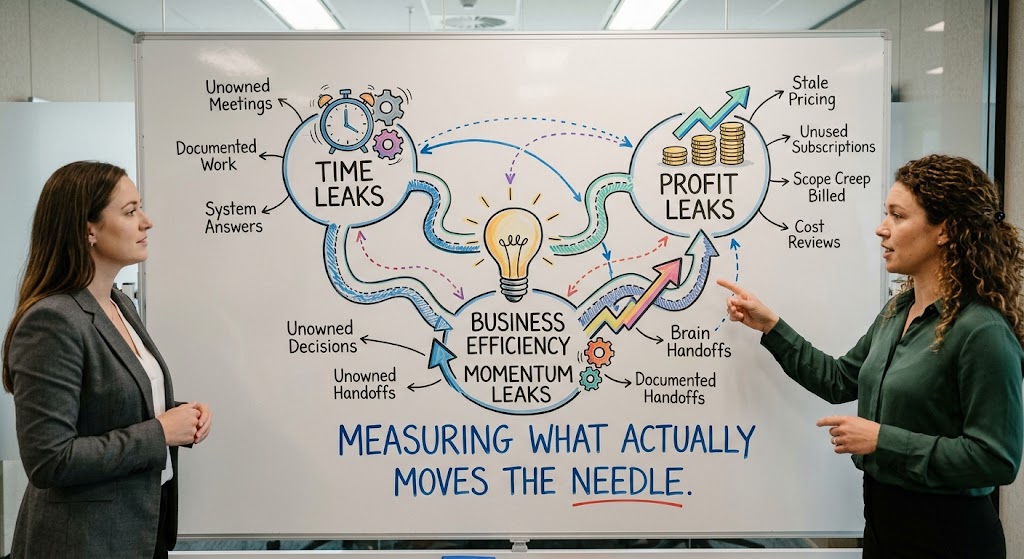
Time Leaks
Hours that vanish into meetings without owners, questions a system should be answering, and work that gets redone because nothing was documented the first time.
Profit Leaks
Margin that quietly erodes through stale pricing, unused subscriptions, scope that expands without being billed, and costs nobody has reviewed since they were approved.
Momentum Leaks
Projects that stall on a decision no one owns, onboarding that lives in one person's head, and handoffs that quietly break every time someone is away.
The AuditWhere the Leaks Hide
When we sit down with a founder for the first time, we're rarely looking for the one big fire. We're looking for the small, repeated patterns that have quietly become the business's baseline. They tend to cluster in the same few places, no matter the industry.
| Leak Type | Where It Hides | Silent Cost |
|---|---|---|
| Time | Meetings without agendas or clear owners | Hours reclaimed nowhere, compounding every single week |
| Time | Founder answering questions a system should answer | The founder becomes the bottleneck for every decision |
| Profit | Pricing set years ago and never revisited | Margin erosion invisible until cash flow finally gets tight |
| Profit | Tools and subscriptions nobody actively reviews | A steady drain that never shows up as one single expense |
| Momentum | Decisions waiting on an approval that never arrives | Projects stall quietly and deadlines slip without warning |
| Momentum | Onboarding that exists only in one person's head | Growth capped by how fast that one person can repeat themselves |
The Blind SpotWhy Leaks Stay Invisible
Leaks survive because busy looks like productive. A full calendar feels like proof of effort. A team that never stops moving feels like momentum. But activity and output are not the same thing, and most businesses have no system that tells the difference — only a founder's gut sense that things are "probably fine," updated in real time by whatever fire is loudest that day.
Without visibility into where time, money, and decisions actually go, a leak can run for years. Nobody is hiding it. Nobody even knows it's there. It has simply never been looked for.
Leak-hunting isn't a finance exercise. It's an operations exercise. The businesses that plug leaks fastest are the ones that stopped assuming "busy" means "productive" and started measuring what actually moves the needle.
The FixHow to Find and Seal the Leaks
Sealing a leak is rarely complicated once you can actually see it. The hard part is building the habit of looking. Here's the practical path we walk founders through.
Audit the Actual Flow of a Week
Forget the calendar you intended to have. Track where a real week actually goes — meetings, interruptions, rework — for five working days. Most founders are stunned by the gap between the plan and the reality.
Follow the Money Line by Line
Review every recurring cost, every pricing tier, and every piece of scope that's crept beyond what was originally billed. Profit leaks hide in things that were approved once and never looked at again.
Find Where Decisions Stall
Map the last five projects that ran late. In almost every case, the delay traces back to a decision waiting on one person — usually the founder — rather than a lack of effort from the team.
Patch the Cheapest Leak First
Don't start with the biggest structural fix. Start with the smallest, fastest win — it builds the team's belief that leak-hunting actually changes something, which makes the next fix easier to land.
Install a Weekly Leak Check
Fifteen minutes, every week: what slowed us down, what cost more than it should have, what decision sat too long. This is the difference between fixing a leak once and never having to look for it again.

The PatternThe Leak Spiral: How Small Gaps Compound
Here's what makes a hidden leak more dangerous than a visible loss: left alone, it doesn't stay the same size. It compounds. A stalled decision creates a fire later. That fire eats the time that should have gone toward fixing the process. The process stays broken, which produces another stalled decision — and the cycle repeats, a little worse each time.
The good news: the spiral runs in reverse just as easily. Every leak you find and seal removes a little pressure from the whole system — fewer fires, more time to look for the next leak, better decisions made faster. Momentum compounds in both directions. The only question is which direction your business is currently facing.
The DistinctionWhat Leak-Hunting Is Not
It's worth being precise here, because "watch where the money and time go" gets misread more often than it should.
It is not micromanagement. Tracking a leak isn't about monitoring every hour a team member spends — it's about fixing the structural gaps that waste everyone's time, so people can actually focus on the work that matters.
It is not austerity. Cutting every tool and every expense to zero doesn't build a healthier business — it just trades one kind of drain for another. The goal is precision, not deprivation.
And it is not a once-a-year audit. A leak sealed in January can reopen by June if nobody's checking. Leak-hunting only works as an ongoing habit, not a project with an end date.
The businesses that protect their margins best don't have fewer problems. They have shorter distances between a leak forming and someone noticing.
Where to StartThe First Leak Is Always the One You Haven't Looked For Yet
Every business has leaks. That's not a verdict on how well it's run — it's simply what happens to any operation that grows faster than its visibility does. The founders who come out ahead aren't the ones who built a perfect system from day one. They're the ones who made looking for leaks a habit, before the leaks got big enough to force the issue.
If you've never traced where your team's time actually goes, or when your pricing was last reviewed, or how many decisions are quietly waiting on you — that's not a failure. It's simply the next thing worth doing.
Ready to Find Out Where Your Business Is Leaking?
We work with founders doing $200K–$5M who want to see, precisely, where time, profit, and momentum are slipping — and build the systems that seal it. Book a free 20-minute Clarity Call. No pitch, just an honest look.
Book Your Clarity Call →