What Is Operational Excellence — and Why Does It Matter?
Most founders chase strategy. The ones who scale chase something more powerful: a business that runs with precision, day after day, without them becoming the permanent fix for everything broken.
There's a version of your business where things just work. Orders get fulfilled. Team members know what they're responsible for. Decisions get made without everything routing through you. Customers get a consistent experience every single time. Deadlines are not events of hope — they're predictable outcomes.
That version of your business has a name: Operational Excellence.
It's not a buzzword reserved for enterprise boardrooms or consulting decks. It is, quite simply, the discipline of running your business in a way that produces the right outcomes — reliably, efficiently, and without burning out the people behind it.
"Operational Excellence is not about working harder. It's about building the conditions where good work is the natural outcome — not the exception."
What Operational Excellence Actually Means
Operational Excellence (OE) has roots in manufacturing — in the lean principles pioneered by Toyota, in the quality frameworks of Six Sigma, in the continuous improvement philosophies that transformed how physical goods were made and delivered. But its core idea translates directly into modern service businesses, startups, and SMEs: eliminate waste, empower people, and create systems that consistently deliver value.
At its heart, Operational Excellence is about the gap between what you intend to deliver and what you actually deliver. Strategy closes that gap in theory. Operations closes it in practice. When your operations are excellent, the two align — and that alignment compounds into growth, trust, and durability.

Operational Excellence begins with visibility — knowing what's happening, why it's happening, and how to course-correct before it becomes a crisis.
For the founders we work with — typically running businesses between $200K and $5M — Operational Excellence isn't abstract. It shows up in very specific, practical ways: whether a client onboarding runs the same way every time, whether a new hire gets up to speed in two weeks or four months, whether you spend your Mondays solving problems or creating new ones.
The Three Pillars of Operational Excellence
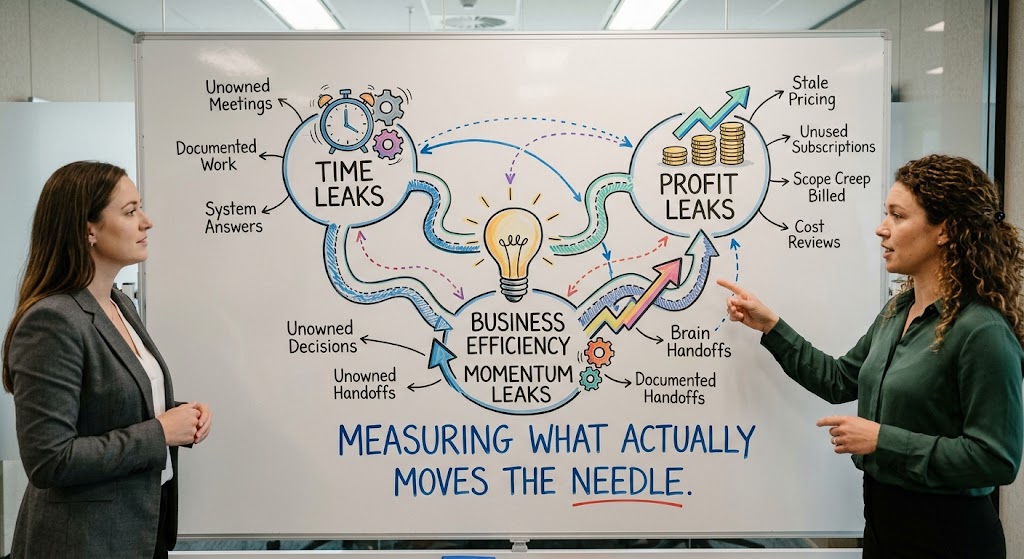
When we audit how a business operates — not its strategy, not its market positioning, but the actual day-to-day machinery — we always find the same structural gaps. Operational Excellence, in practice, is built on three interconnected pillars. When all three are present, the business runs. When one is missing, everything else strains to compensate.
Clarity
Everyone knows what matters most, who owns what, and what done looks like. Without clarity, effort disperses into activity that feels busy but moves nothing.
Systems
Repeatable processes that produce consistent outcomes — without relying on the same person, the same memory, or the same heroic effort every time.
Visibility
Real-time insight into what's working, what's broken, and what's drifting. You can't manage what you can't see, and most businesses are flying blind.
These pillars aren't independent. A business can have good systems but no visibility into whether they're working. It can have dashboards full of data but no clarity on what that data should inform. The three work together — and when they do, something significant happens: you stop solving the same problems repeatedly, and start building momentum instead.
Why Operational Excellence Matters Now More Than Ever
The environment most businesses operate in today is not forgiving. Customer expectations move faster than most operations can adapt. Teams are leaner, often hybrid or remote, which means informal coordination — the hallway conversation, the spontaneous alignment — happens less. Founders are being asked to do more with less, while the complexity of their businesses only grows.
In this context, operating on instinct and willpower has a ceiling. And most founders hit that ceiling between $500K and $2M. The business that got you here will not get you there. Not because the strategy is wrong, but because the infrastructure underneath the strategy hasn't been built.
The Executo Observation
The founders who scale past $2M without burning out are almost never the ones with the best ideas. They're the ones who built an operating layer underneath their ideas — systems, rhythms, and visibility that let the business execute without them in every room.
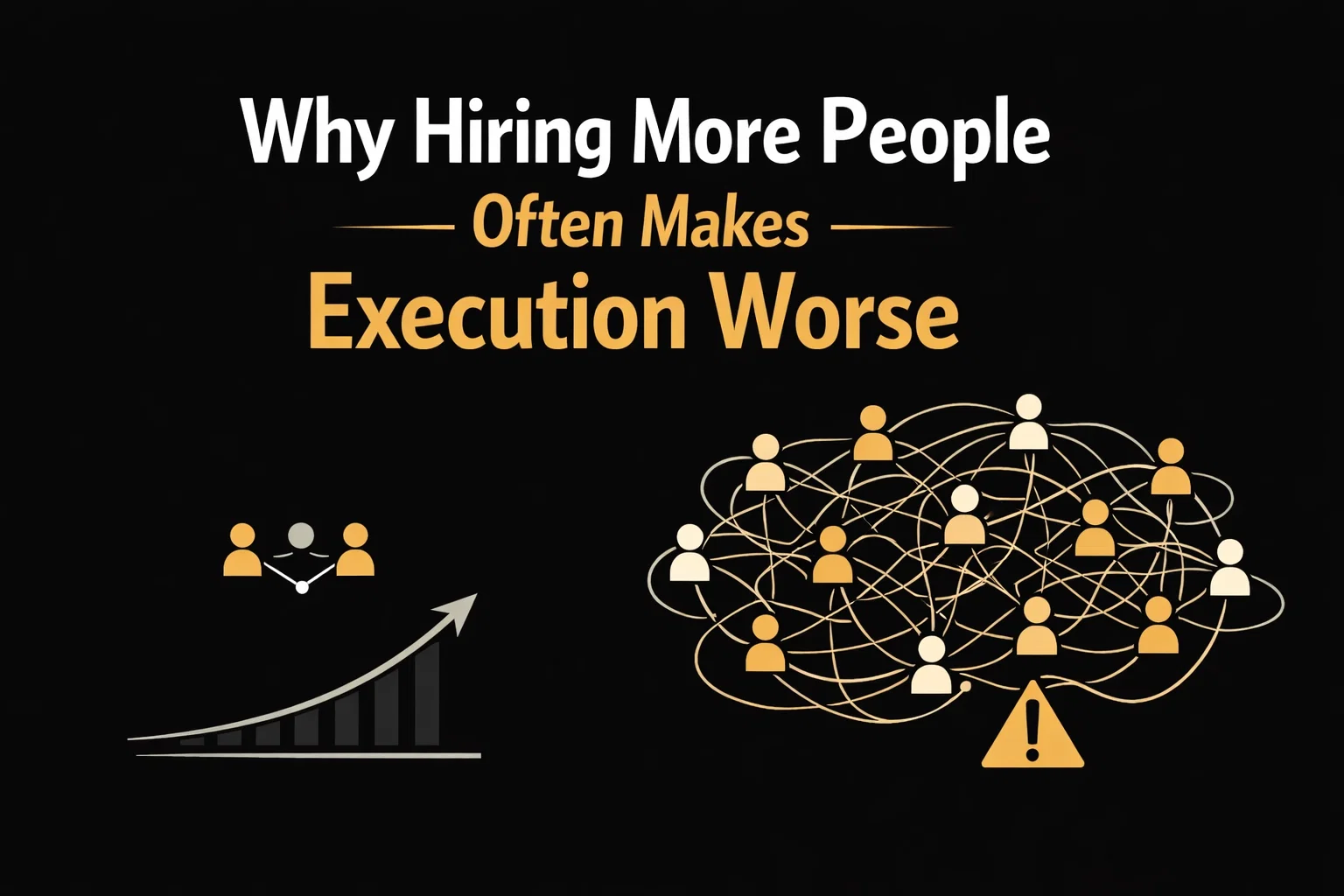
Operational Excellence matters because growth without operations is just chaos at a higher altitude. The customer complaints multiply. The hiring doesn't stick. The quality wobbles. The founder works harder and harder trying to hold it all together — and eventually, something gives.

Operational Excellence shifts the founder from firefighter to architect — from constantly reacting to deliberately building.
The Difference Between Operations and Operational Excellence
Every business has operations. Not every business has Operational Excellence. The distinction matters more than most founders realize.
| Dimension | Typical Operations | Operational Excellence |
|---|---|---|
| Decision-making | Routes through the founder | Distributed, with clear protocols |
| Processes | Informal, person-dependent | Documented, repeatable, improving |
| Performance data | Reviewed in crisis | Monitored continuously |
| Team accountability | Founder-enforced | Built into the system |
| Quality consistency | Varies by who's available | Consistent regardless of who delivers |
| Growth mode | Founder scales effort | Business scales systems |
The left column isn't a failure — it's where every business starts. The right column is where businesses that last end up. The move from one to the other isn't about hiring a COO or buying software. It's about making a deliberate decision to build operating infrastructure, and then actually building it.
How to Build Operational Excellence: A Practical Path
Operational Excellence is not achieved in a single sprint. It's built in layers, over time, through deliberate practice and honest feedback. But the path is knowable — and it's shorter than most founders expect.
Map the Current Reality
Before you can improve how the business runs, you need to see how it actually runs — not how you think it runs. Document the five or six processes that touch the most customers, generate the most revenue, and consume the most team time. What you find will surprise you.
Identify the Biggest Friction Points
Once you can see the business, you can spot where effort disappears without producing outcomes. These friction points — the handoffs that break down, the decisions that stall, the tasks that get repeated or missed — are your highest-leverage starting points.
Build Lightweight Systems
Don't overcomplicate this. A system doesn't need to be elaborate software — it needs to be a clear, repeatable way of doing something that produces a consistent result. Standard operating procedures, templates, checklists, and decision frameworks are systems. Start there.
Install Rhythm and Cadence
Operational Excellence runs on rhythm. Weekly team syncs, monthly performance reviews, quarterly planning cycles — these are the heartbeat of a well-run business. Cadence turns intentions into habits, and habits into institutional capability.
Measure What Matters
Pick three to five key metrics that tell you whether the business is healthy. Revenue is one. So is customer retention, team utilization, and time-to-delivery. Review them on a regular schedule. What gets measured gets managed — and what gets managed gets better.
The OE Flywheel: How Momentum Compounds
Here is what most founders don't anticipate about Operational Excellence: it is self-reinforcing. Every system you build makes the next system easier to build. Every friction point you eliminate creates capacity to eliminate another. Every metric you start tracking surfaces insights that improve the business in ways you couldn't have predicted.
This compounding effect is why the businesses that invest in Operational Excellence early outperform those that treat it as something to "get to eventually." The sooner the flywheel starts spinning, the more momentum it generates — and the harder it becomes for competitors operating on instinct alone to keep pace.
What Operational Excellence Is Not
It is worth being precise about what we're not talking about, because Operational Excellence is frequently confused with things that dilute its value.
It is not micromanagement dressed up in language about systems. Operational Excellence distributes ownership — it doesn't consolidate it. A business where the founder has documented every process but retained every decision is not operationally excellent. It is a manual held together by one person.
It is not bureaucracy. Systems exist to enable speed and consistency, not to create approval layers and permission structures that slow everything down. If your systems are making things harder, they're not systems — they're friction in different clothes.
And it is not a destination. The most operationally excellent businesses on the planet — Amazon, Toyota, Shopify — treat improvement as a permanent state of mind, not a project with a completion date. Operational Excellence is a practice, not a place you arrive at and stop.
"The businesses that last don't get lucky more often. They build operating systems that make good outcomes more likely — every single day."
The First Step: Honest Assessment
The single most valuable thing a founder can do before building anything is to look honestly at how the business actually runs — not how they believe it runs, and not how they'd like it to run, but what actually happens when they're not in the room.
That honest assessment almost always reveals the same things: processes that live in someone's head, handoffs that regularly drop, metrics that aren't being tracked, decisions that stack up waiting for founder approval. None of this is a reflection of how smart or hardworking the founder is. It's a reflection of what happens to every business that grows without deliberately building its operating layer.
The good news: every one of those gaps is fixable. Not overnight, and not without effort — but within a structured 90-day engagement, we've seen businesses move from reactive chaos to genuine operational rhythm. Not because we brought magic. Because we brought method.